Tuesday, October 11, 2016

The First Page of Your Novel

Whether you're a writer or not, knowing what attracts you to books can be a helpful way to sort through the millions out there. When do you know you're going to love a novel? How does the cover help you decide? The title? The first line? The first page? The first chapter?

There's been a lot of advice for novelists to make sure the first line is an eye catcher, the first page riveting. Otherwise, an agent might put it down, as well as a prospective reader.

So what is a writer to do?

The other day I picked up the book IQ84 by Haruki Murakami. The title of this novel doesn't do much for me - I have no idea what it means, so it remains a riddle. But it also isn't offensive, nothing that would turn me off. Same about the cover. It's simply okay. The eyes of a Japanese woman peer out from it, but there is a graphic design component to it that appears modern and a little surreal, his specialty.

There's a title to the first chapter: Aomame: Don't Let Appearances Fool You. I have no idea what the first word means (we find out in the first couple of pages). The warning which follows is almost cliché, but it still serves to pique my interest.

The first sentence is nothing extraordinary. "The taxi's radio was tuned to a classical FM broadcast." However, through this line, my ears (one of my senses) are involved, and a scene unfolds.

Within the first paragraph, there is a sentence that speaks to me of the author's style, a simile: "...like a veteran fisherman standing in the bow of his boat, reading the ominous confluence of two currents." It's a talented line that impresses me.

By the end of the third paragraph, I believe I want to read this novel. Why? Because of these lines: "This may be the most important proposition revealed by history: 'At the time, no one knew what was coming.' Listening to Janáček's music, Aomame imagined the carefree winds sweeping across the plains of Bohemia and thought about the vicissitudes of history."

My conclusion: there's intellectual depth to tis novel. The only hesitation is that it's about a thousand pages, so I'm not 100% sure.

Which leads to the idea of meeting the reader's expectations. The cover, title, and first page of a romance novel is going to be different from those of a sic-fi fiction novel or a literary work.

One thing you want to remember: the first page of your novel should promise something, and the rest of your novel should deliver it. 

Here's another example: One of my favorite reads this year was Yanagihara's A Little Life. The cover: a man's face, a man who looks to be in pain at least, perhaps emotionally tortured. Dead on. The title, mystifying. What is a little life? Is the phrase an oxymoron? The first line is a long sentence - it perhaps warns the reader not to expect choppy in vogue sentences here, and also to expect literary style above popularity.

And the reader is thrust into a scene immediately, even rejected in a sense by a potential neighbor, then rejected by the agent showing YOU an apartment, and yes, somehow the experience of the character feels like your own. Such is the talent of a writer like Yanagihara. This is also a very long novel, maybe 700 pages or so, but I am pretty certain in an instant I'm going to read it. Why?

Because the last highly significant component in the beginning of your novel is content! A Little Life is about complex relationships among four young men, so this at once fascinates me. More emotion is evoked in the first several pages than throughout some entire works, and this hooks me.

I've spent some time thinking about the beginning of novels. I've written three and am working on a fourth. The first three are a trilogy, so the first few paragraphs of the first novel have to introduce, in a sense, not only the first novel but also the other two.

So, let's consider an example of mine: The Search For Intelligent Life On Earth: A Story of Love. The title is intriguing, and the subtitle helps the reader know what to expect. This is not sic-fi but not exactly a love story. Otherwise, it would say "a love story."
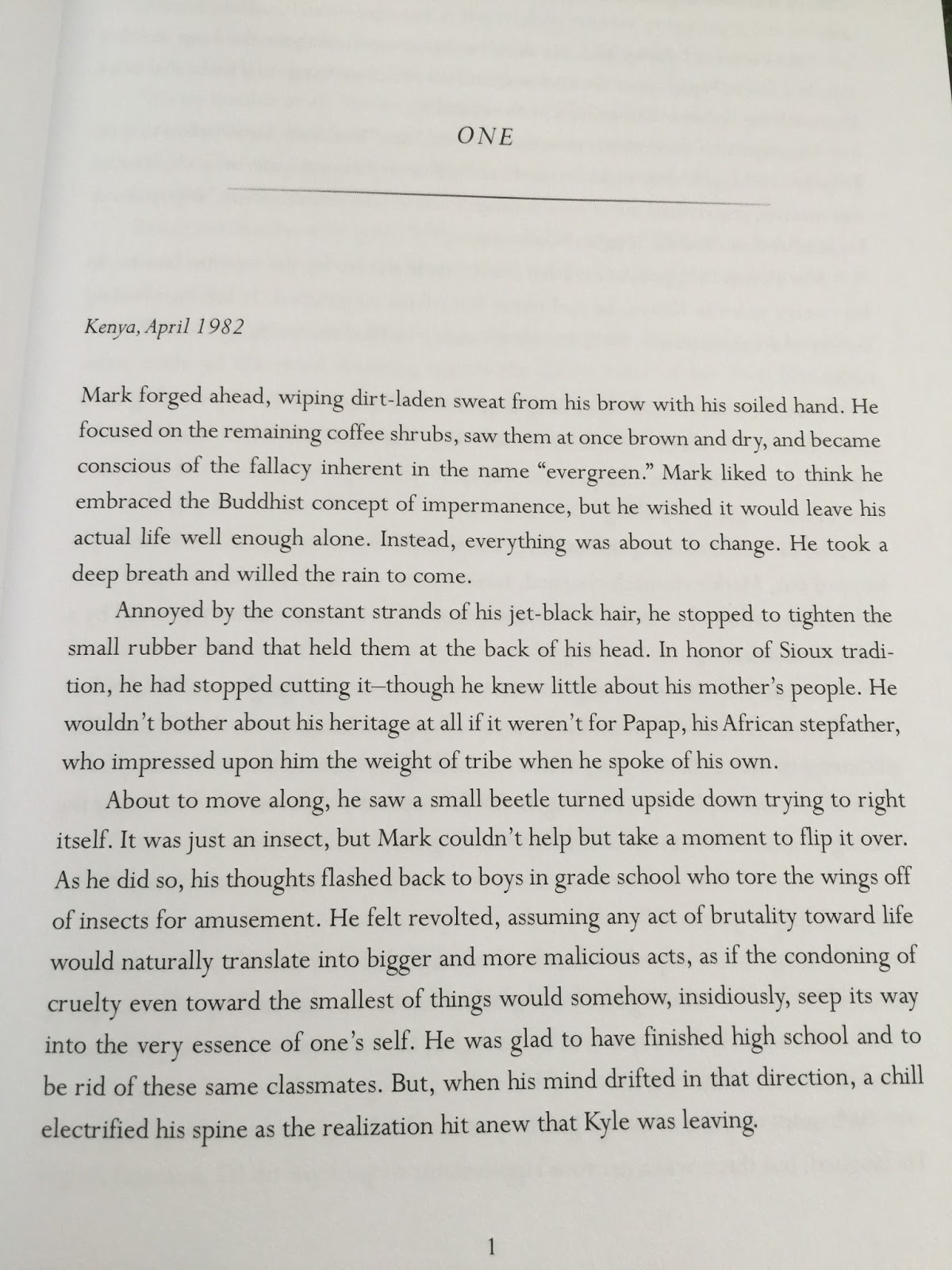
The first line, again not brilliant, brings the reader into a scene: "Mark forged ahead, wiping dirt-laden sweat from his brow with his soiled hand."

The first paragraph introduces a spiritual philosophy and the human character's flaws through this line: "Mark liked to think he embraced the Buddhist concept of impermanence, but he wished it would leave his actual life well enough alone." The reader now knows this is not just a light story. There's something profound that will be addressed, so the novel may be literary or cross-genre.

By the third paragraph, we have more depth and an element of style revealed through this line: "...any act of brutality toward life would naturally translate into bigger and more malicious acts, as if the condoning of cruelty even toward the smallest of things would somehow, insidiously, seep its way into the very essence of one's self." Now the reader knows for sure this isn't a romance novel.

So, what do you want to do?

1) Pick an attractive cover design, or at least one that's not offensive to most. One that hints at what's in store between the covers.

2) The title should properly reflect what the reader should expect. If you're writing a piece of eroticism, "Hot and Bothered," may be an appropriate title. Conversely, the same title can be used ironically to signify a non-fiction work on febrile conditions, or a biography of a manic politician, for example.

3) The first line should transport the reader into a scene, so she is immediately involved in real time.

4) The first page should reveal style, intent, and purpose of the novel, so a reader will know if he will enjoy the book (or at least have a strong suspicion one way or another). Yes, we want to appeal to as wide an audience as possible. But sometimes I wonder if by making commercial appeal the main priority, we are negating the artist in the writer.


Monday, March 28, 2016

My Favorite Reads on Writing

It's easy to become inundated with books/blogs on how to write. To help you narrow it down, I've selected seven of my favorite reads about writing:


Best from a best-selling author: On Writing: A Memoir of the Craft, by Stephen King, inspires you to employ the nitty-gritty style and discipline of Stephen King's approach to writing. Memoir, muse, and advice, On Writing is a great addition to any writer's library. King's book is practical while also being funny, personal, and well, here's a quote from the second foreword: 
"This is a short book because most books about writing are filled with bullshit."

Bottom line: Some of his recommendations are most appropriate for genre fiction, but the overall contribution of the book is worth the read if you write anything from non-fiction to literary. 
Personal comment: I don't read horror, so this is actually my favorite of King's books.


Best for nonfiction writing: On Writing Well: An Informal Guide to Writing Non-fiction, by William Zinsser (from a Yale course he taught). Masterful writing about writing, Zinsser's is a classic for tips on usage, style, simplicity, words, and special areas such as writing for your job and writing interviews. 

Bottom Line: Excellent all-around text for becoming a better writer.
Personal Comment: On my list to re-read.


Best for popular fiction writing: The Writers Digest Handbook of Novel Writing. All the basics and instructions in a how-to manual for writing popular fiction, and I quote, "Practical advice and instruction on creating the novel - from first idea to plots and subplots to outlining and writing and contacting editors and working with ideas."

Bottom Line: What more can you ask for if you're an aspiring writer or just need a little inspiration? 
Personal Comment: Someday I'll have a best seller! In the meantime, I'm writing what I love and hoping people fall madly in love with cross-genre, literary stories. 


Best for literary fiction writing: Reading like a Writer: A Guide for People Who Love Books and for Those Who Want to Write Them, by Francine Prose. All the best literature in summary form. 

Bottom Line: Love to read literature? Read this.  
Personal Comment: Reflects one of my favorite sentiments, as I've always recommended reading as the best instruction for writing.


Most useful: The Elements of Style, Strunk and White, another classic in the field, provides concise education on rules of usage, principles of composition, and approach to style.

Bottom Line: A college education should not be considered complete without this little book.
Personal Comment: Even if you have a PhD in English, you might still need it.


Most entertaining: Eats, Shoots and Leaves: The Zero Tolerance Approach to Punctuation, by Lynne Truss, will have you in a jolly mood as you learn to correct your English grammar. Less about writing and more about the de-evolution of the human species as seen through the eyes of a grammarian, this one might have you rolling in the aisles (yes, I snuck it into a concert in Tucson, Arizona once). This book was a best-seller. 


Bottom Line: LOL. 
Personal Comment: Read it! Seriously; don't, forget. To read it.


There are certainly many others I could recommend, including books that incorporate getting published, reading fiction alongside exercises for writing or writers'  memoirs with tips for writing. There are also books that assist with literary analysis. However, I've selected the ones I've enjoyed most over the years. I'm always open to hearing about great books, including those about writing. If you have any other suggestions or favorites, please feel free to post a reply.


Monday, January 11, 2016

Risking Your Writing

Winston Churchill once said, "Success is the ability to go from one failure to another with no loss of enthusiasm."

In an attempt to figure out genre fiction, this novelist took a risk and wrote a short story – well, it was intended to be a short story, except that I couldn't keep it under seventy-five hundred words. Thus, in line with recent e-book lengths, I decided to write a short novella. In its entirety, the story ended up just under thirteen thousand words.

My intention was to write a casual, entertaining, comedic MM romance, which was also a coming-out story that highlighted changes in perceptions and tolerance levels in recent times. 

The story, which I entitled Desperate In Sheridan, is about two friends who grew up together but have been apart for a long time. Brad is gay and doesn't trust his cowboy-cultured best friend to accept his sexuality, and Jimmy is a young man who has suffered a lot of losses.

There's a lot of perceived desperation in this story. Brad is desperate to find his happily-ever-after, although he no longer believes in it after a rough break up. Jimmy wants to keep his only connection to his childhood and family in the form of his best friend, Brad. And Wendell was a model from California before he moved to Sheridan, where he's had a bit of a dry spell.

Despite the fact that I was trying to write genre fiction (MM romance), I loath to be formulaic, which in this case would be something like boy meets boy, boy attracts boy, obstacle keeps boy from boy, boys overcome obstacles and fall madly in love. Yeah, there's a little bit of that in my story, but it's mostly unrecognizable. Instead, there are surprises throughout the story that I wished to have mimic how unexpectedly random reality can be. 

I submitted the text to a group of MM romance readers, who, in turn, read the story and reviewed it for me. (Currently, the story remains free on smashwords and multiple online retailers.) The result was quite mixed. Despite the fact that it was advertised as a light, comedic, and short novella, many wished it to be longer and wanted more character development. At the same time, others did not like that the story did not meet formulaic standards.

In the end, about 70% of the people who rated and/or reviewed it so far gave the story three stars or above, indicating they liked it, and 30% indicated they did not (with the most common complaint being they didn't get the characters). As a literary writer, whose only other material happens to be a novel in which the main plot line is a love story between two young men, I am still desperately seeking my audience. Did this experiment in Romance help? I'm not sure. But it got people talking about my work (even if it was a side-story of mine) and gave me things to contemplate. 

Bottom line is that I took a risk trying this experimental story with an established group of MM romance fans. In general, the experience was positive, and I can apply the feedback I received in creating better short stories in the future (novella length or under). I also learned that there was no way to please everybody, and that probably the best thing for me to do is to write what I love and worry about genre/category afterward.

I have written several other novellas - these are about twice as long as this one and maybe more perfectly sized to explore some of the detail my reviewers mentioned. I would love to continue with Desperate in Sheridan, whether that's a part two or a remake into a novel, but it might need to wait while till I complete other projects. This includes the editing of the trilogy that starts with The Search for Intelligent Life on Earth.


I highly recommend taking risks with your writing: trying new styles, seeking acceptance into different genres or popular fiction circles, and entering contests and free review programs. It's all about learning and improving, so long as you're enjoying yourself. And remember: as with life in general, what you take from your experiences is what decides your level of success.


Friday, September 25, 2015

Dealing with Anxiety as a Writer

Few things can blow our minds better than anxiety. Everyone deals with major life events, sometimes occurring at once. While some may be "good" (such as, for me, preparing for a trip or publishing my book), they still evoke similar physiological responses to stress as unwanted events might. Take the book project, which is the closest I'll ever get to giving birth in this lifetime (I suspect it's not as painful, but considering the decades of gestation period...), just as I think I'm nearing the end of the work, something comes up that makes me want to revise, edit, or burn the manuscript.

What did I do the other day when I was tripping? Some simple methods to calm myself down before I do something I might regret:

1. Reach out to a friend. I called a fellow writer who talked me down.
2. Make a list. It helps diminish the nebulous cloud of worry. Plus, I was able to check things off (or scratch the hell out of them off the page).
3. Sit with the anxiety. Feel it. Write about it. Coax it - what we resist could persist. (There are mindfulness or meditation practices I like to use.)
4. Watch something funny or engaging on TV or read something uplifting.
5. Go for a walk or run - especially surrounded by nature. Helps to ground!
6. Work out/lift weights.
7. Eat something nutritious, even if I have to force myself. Our tendency when stressed or worried is to eat or drink junk. A little discipline goes a long way here.

I also try to remember that time passes, and with it, the anxiety.

But let's say that these methods have been tried and only limit our nerves to a small degree. Then we might need to look at something like cognitive therapy. What is that? It's an opportunity to look at your thoughts, especially the ones that heighten negative states like anxiety and depression, and rebuild them using rational thinking and "evidence" to the contrary.

For example, let's look at the thought, "I'm never going to succeed as a writer (or as whatever)." You might say the odds are stacked against you. Well, you'd be 100% correct - if you never write or bother to publish. Do you think every successful writer was convinced of success before he/she reached it? Do you think it will help you feel better if you sit around and lament? Would your time be better off learning about writing, marketing, etc..., than giving yourself negative self-talk?

ALSO, have you ever been surprised by an outcome before? If so, is there a chance you might be again? You get the gist.

Most importantly, when I'm going through self-doubt, I ask myself if there's anything I'd really rather be doing than writing these characters? The answer is usually no. That being the case, how can I be wasting time? If the answer is yes, then maybe I'd move along my merry way looking for my bliss elsewhere.

Anxiety can be a mobilizer rather than a deterrent. All it takes is a little practice.
For more on mental health, check out this writer's blogs at The Search For Love, Sex, and Self in Relationships: here. And happy writing!

Tuesday, March 17, 2015

What Makes The Great American Novel So Great

Nowadays we tend to judge a book by its sales. And perhaps that's how it should be. After all, we're trying to make a living, right?

But when I think about what makes a novel great, I think of two major elements:
1. the amazing combinations of words, and
2. the transcending capacity of the subject matter. 

As a writer, I sometimes struggle to take a thought, scene, or description and make it into something beautiful to read, something gorgeous in its layout and evocative in its power. Also as a writer, I write Big Concept fiction, meaning, for me, that I want to commit my writing to the betterment of the world somehow. 

Recently, I re-read a small book by John Knowles called A Separate Peace. More than anyone else, it's important for writers to read great works of art. It serves as a reminder when we're punching away at keys all day that we want to create something worth reading. 

Knowles is a craftsman of words, an icon of prose, and a sage. There are sentences both so profound and skillfully designed that one would have to be heartless not to want to read them again and again.  


Sentences like this one of setting: 

"Someone was coming toward me along the bent, broken lane which led to the dormitory, a lane out of Old London, ancient houses on either side leaning as though soon to tumble into it, cobblestones heaving underfoot like a bricked-over ocean squall - a figure of great height advanced down them toward me."

Or this one on feeling:

"I felt fear's echo, and along with that I felt the unhinged, uncontrollable joy which had been its accompaniment and opposite face, joy which had broken out sometimes in those days like Northern Lights across the black sky."


Or this one about inner demons:

"All of them, all except Phineas, constructed at infinite cost to themselves these Maginot Lines against this enemy they thought they saw across the frontier, this enemy who never attacked that way - if he ever attacked at all; if he was indeed the enemy."


A Separate Peace takes place at an exclusive boarding school for boys during WWII (1942/43). As the students prepare for their diplomas and break the rules and feel so deeply, the looming reality of the war out there is forever present, as is the one in here. It portrays masterfully what it is like to be adolescent (not just chronologically, but in mentality), and it speaks to us today just as it did to the reader in 1959. The novel is as relevant right now as it was then. And this quality is what I mean by transcending. 


I will always strive to bring the deepest truths to light in my work and to use the English language with reverence. My recommendations for writers of literature:

1) Read. Read the best there is, so you can raise the bar for yourself. 
2) Write poetry - not necessarily prize-winning or recital-ready, but poetry you generate for the sole reason of falling in love with the language. 
3) Edit. Read what you write aloud to yourself. Listen. Edit some more. Look words up. Read what you've written again. Listen to it. Edit and re-edit. 
4) Keep a notepad on you and jot down moments of inspiration as they occur. 
5) Live. Experience. Think. Talk with people. Ask them about themselves. Grow wise. And keep writing. 

Wednesday, December 17, 2014

Write what you know: Fallacy 101?

When was the last time you visited the twenty-fourth century OR wandered in a desert by yourself for months OR been to Middle Earth? Well, the answer would be NEVER if we followed the common advice that writers should stick to writing only what we know. Think about it, there would be no fantasy, no sic-fi, and no historical fiction. No Star Wars, no Lord of the Rings, and no Outlander.

Even in popular genre fiction like romance, no one can expect any one person has done all that (well, yeah, it's feasible, but...)Instead of sticking to what we know, I would modify the suggestion to such: First, cultivate imagination. Then, either write what you know OR what you can research.


Imagination is a necessary element in the art of writing, even in non-fiction to some extent, but certainly in fiction. Otherwise, whose story are you telling? Are you merely recounting someone else's tale, a myth, or an event? I would even argue that imagination helps us TO KNOW things we might otherwise not experience. The power of the mind is enormous, and it may seal experiences in our brains as if they really happened. A few suggestions to help step it up:

  • Learn to daydream. You probably did this as a child. If you stopped, and you want to be a writer, you're in big trouble! Relearn it. 
  • Practice meditation or mindfulness to empty the chatter-ridden mind for a few minutes and allow for imagination to soar. 
  • Read good literature and poetry - the type that evokes emotion and brings forth images. I can't stress this enough. I recently posted an article about how positively the brain responds to fiction, and literary fiction was even more beneficial. It's worth checking out on my G+ page. 


Research what you don't know. Everything is available in the library, online, through other people, or by taking on direct experience. Remember when you were in school and you had to write a research paper? Well, gather those skills and do it again.

  • Writing about a carpenter? Take a wood-working class. 
  • Is your book about a heroine in Renaissance Italy? Read about the time period and other accounts of women in that era. 
  • Does your protagonist have a facial tic? Interview a doctor on all the potential etiologies of tics. 

My first novel in the series The Search For Intelligent Life on Earth, A Story of Love, takes place in a variety of countries/states. I've been everywhere but one place. Can you guess which one based on the descriptions or lack thereof? Remember to put the knowledge you gain - either by direct experience or through research - into the eyes and ears of your character, and you're good to go!

Happy Writing! Happy Holidays!


Thursday, October 16, 2014

Death by Adverbs? Hardly!

I had just taken a gulp of my drink and joined a circle of friends in discussion when a fellow Sunday loafer announced he decided to become a writer. He read a couple of books on writing and took a workshop. Thus, he elucidated us on never using adverbs because that's what he was taught.

Of course I am familiar with this argument. I am also aware that plenty of fabulous writers use adverbs, and that sometimes it's a stylistic preference. In other instances, there's no other word that will convey the same thing as an adverb. But, since it can be challenging to go against prevailing sentiment, let's narrow it down.

Here are opportunities to use adverbs fearlessly: 

1) Dialogue. How does your character speak? Does he/she use adverbs? Do they enhance the dialogue by making the character's speech stand out or intimate his/her upbringing, class, or geographic origin?


2) Poetry. If you want the sentence to read well, sound it out (read it out loud). If the rhythm doesn't work, change the sentence. It could be that an adverb is just what you need.

3) Precision. Sometimes an adverb is perfectly precise. Avoid unnecessary usage (again, because they are out of favor right now), but dare to utilize them when they do enhance. 

For example, you might not want to write the sentence, "She whispered softly." Do you see why? Softly/quietly are implied in the word's definition. However, what if you've already used the word whisper eight times in the last page, and a collection of synonyms like utter, mutter, mumble, and mouth just don't work. Then you might want to say, "She spoke quietly again."


At some point, I will probably go in and take out some of the adverbs in my first novel. There are more than a few unnecessary ones. But, then, I wonder, Gee, if I wait long enough will they suddenly and unexpectedly become trendy again?


4) Stream of consciousness. Are you writing in contemporary-style third person? Then stream of consciousness narrative is somewhat like dialogue. If your character thinks in adverbs, then he or she thinks in adverbs. Adverbs are real words. Don't let someone else's opinion dictate your style, or your character's.

Happy Writing!

I am available at www.gerrypirani.com


Sunday, September 21, 2014

Save Me, or the Problem with You and I

I was watching television once and heard someone say, "It was for I." I nearly fell to the floor – instead, I was lucky enough to catch my chin on a piece of furniture. When teachers drummed You and I into our heads as small children, they apparently didn't help our developing minds distinguish between subjects and objects, and the only surviving element of their criticism was that "ME" is somehow bad. This blog is an attempt to save me.

As writers, are we obligated to take language seriously and assist the public (and our readers)? Maybe teachers are the ones morally obligated, but I've heard English and elementary school, high school, and college-level teachers say the following types of things a number of times:
"to he and his wife"
"with you and I"
"Her and her husband are going."

When I've asked them (I can be awful) if they know that their grammar is incorrect, they inform me that they do NOT know. They say that it was not emphasized in their educational programs.

Is this like an auto mechanic who never learned how engines work?

The inaccuracies do not appear related to education level or profession. Your attorney, doctor, and minister all might say "Listen, between you and I..."


Let's have a brief overview.

First, the fundamentals:

1. Me is a bona fide English word. You can practice saying it in front of the mirror. "Me" rightfully belongs in some sentences. It is an objective or accusative pronoun. Objective means that it has something done unto it. It is passive.

For instance, let us look at the sentence: "Give it to me!" Me is properly used here as the object of the preposition to.

Now, to really test you, which is correct:
A) Give it to Jacques and I!
B) Give it to Jacques and me!

B, of course. Why? It does not matter how many people are being given, they are objects all the same. You could say: "Give it to John, Lilith, Mark, Kyle, and me!" 

Now my friend Bob states that usage eventually becomes rule in language. If this is the case, I'll be on the next shuttle to one of the "new" planets in our solar system, cuddling up with a blanket of Me’s. 

2. Whom does not speak. In fact, whom does not do anything. Why? It is an object. I have seen people write comments such as: "I like Joe, whom says that…" This sentence is the grammatical equivalent of "him says no," an atrocity that brings us to number three:

3. If it sounds ridiculous, it most likely is ridiculous.

4. "Between you and I" is blatantly offensive. See number one above. Between is a preposition, and, as such, it deserves objects. Other prepositions frequently robbed of proper objects are with and for.

These are correct:
That is between him and her.
I'll go with John and her.
The gift is for Mark and him.
Does she want to go with you and me?
It meant the same to him and us. 

5. It is I is an exception because of the verb to be. Let's just leave it at that.

6. English is easier than German when it comes to pronouns. In English, you don't have to worry about the dative. If you don't know what this is, consider yourself fortunate, stop complaining, and learn your English grammar.


I know it's a lot to ask, but when I'm reading an extremely well formulated and researched novel that then has an educated character in the 1800's say between you and I, it pulls me right out of my suspension of disbelief. I doubt that's what the author intended.


Wednesday, July 23, 2014

For free or not for free?

About fifteen or more years ago, I heard that the novel was dead.
I assumed it meant that people weren't reading (a reasonable assumption with all the attention deficit problems).
Then Oprah's Book Club and JK Rowling happened. A revival was staged.

Now I realize that the novel is dying.
Why?
Because people are willing to pay 99 cents, or $1.99, or maybe $2.99 for an electronic book. It doesn't matter that the book is maybe 10,000 words (or anywhere from 5,000 to - and here's a stretch - 40,000 words). So, they are not reading novels. They are reading short stories or, at best, novellas. I purchased some of these to check it out.

I thought about separating my story into 3 novellas (it is about 100,000 words), but the book had a life of its own. As most writers will tell you, the story itself is sometimes in charge. Furthermore, I am writing 2 sequels and a sister novel. Oy.

And, here's the real kicker. People say, "Oh, you should 'sell' your book for free." Why? Because other writers do this.

So, to my fellow writers, I have two questions:

1) What other job are you willing to do for free? Are you willing to wait tables for free? Cut hair for free? Provide legal representation or psychotherapy for free? What about pick up trash, deliver mail, or fix the plumbing at a customer's house - for free? Maybe you're a realtor, and you choose to forgo your commission, just for kicks. 

2) Do you hope to make a living as a writer, or is writing just a side hobby? I think there might be a lot of people who fall into the latter category, and unfortunately it affects all of us. Believe me, I understand the marketing strategy: give away the first, so people will buy the second and the third. Still, it doesn't always work that way. Does it cheapen our art and devalue our media in the meantime?

Solutions?

1) Write a short story (under 10,000 words) to give out for free or 99 cents. If people like your writing, maybe they will buy your novellas and novels. I am in the process of writing shorter stories, maybe a couple of novellas myself. I love writing, so this part (unlike marketing) is not difficult for me.

2) Stick to your guns. Enter contests, take book tours, seek a publicist and/or agent, and charge for your work. Have patience. If it has merit, the book will probably sell at some point. At 100,000 words, my novel is actually a bargain compared to much shorter stories selling for less. Maybe we can start a trend to determine price per word, like labels in grocery stores give you price per ounce. 

3) Remind people that they pay about $5 for a coffee. (I recently paid $6 for a small latte and realized, Damn, I could have bought my novel.) What we choose to prioritize - and spend money on - reflects our cultural and personal values. 

This all said, Amazon is giving away my book for free for people who have "kindle unlimited." I'm not sure what this means to me as the writer. But, that's a whole other blog...

Thoughts on free or not for free?

Sunday, June 22, 2014

Book Marketing (Fiction)


May I say that marketing my novel has been a harrowing experience - a bone-chilling, stomach-upsetting, and headache-inducing venture? Even worse, it takes time away from writing. Probably many writers today feel this way (maybe not so strongly). 

Sure, I would prefer to live in the world of my imagination than in the realm of social media, marketing research, and things like blog tours. (Remember when the word Blog would have just been confused with The Blob? Not that I'm really that old - just feels like it today.)

Worse than that: did you know that non-fiction is published (traditionally) at a far greater rate than fiction? Why? Strategic non-fiction sells, so publishing houses are taking less risk with it than they would be with fiction. 

Of course, when fiction hits, it hits big and keeps hitting. Contemporary (American) society is so brand-oriented, that once established, an author may even put his/her name to someone else's writing and keep selling.

To get to my point: people read non-fiction because they want to walk away feeling smarter than they felt before they read the book.

This is ironic because storytelling as a means to educate is in our genes. It's the way we have, as a species, learned to cope with the riddles of life, pass on our principles, and make way to create a more cohesive society. 

Reading well crafted fiction provides a means to learn new things, foster empathy, and create archetypes, which then may affect our subconscious minds and help us grow into something much grander than what we are. 

Over the course of my series The Search for Intelligent Life on Earth, I propose a more meaningful approach to the very transitory nature of life on our planet, a more spiritual version of what love and human relationships can be, and a more adult (or emotionally mature) interaction between lovers. 

In other words, my desire through this series is to provide a new interpretation of who we are.

And, yet, lofty ideals aside, I am left with the need to market. I am an "unbranded" writer, so readers are also wary to take a risk. There are so many books out there these days, you could lock yourself in the proverbial broom closet (equipped with a recliner and reading lamp) and spend the rest of your life reading - and still make little headway. 

I don't have the answers when it comes to this particular riddle, but I hope that my writing will stand the test of time, that my characters will embed themselves in the minds of my readers, and that the lives of others will be enhanced by my stories. 

Comments are always welcome. I am available at My Website.

Monday, June 16, 2014

How long have you been writing that?

Some of my readers know that it took me about twenty+ years to finish my first novel - not that I was writing every day (nor, dare I admit, even every year!) during that time, but still, it took a while. During those years, I kept thinking I would eventually send it out to publishing companies and agents, but I never seemed to find the free time to get it out to more than a handful of people. 


As many writers know, the business end of things (publishing, marketing, and such) is challenging for the introverted, artistic type - the tortured, introverted, artistic type. Okay, just kidding there. I wasn't tortured - except when it came to query letters and varying length synopses.

So, I kept editing instead - a good thing since writing styles changed over the course of those decades.

Here are a few tips for anyone out there who's taking as long as I did. They might save you some grief.

1. I'm sure you've heard not to get too attached to the words you've already written. That one took me a while to integrate into my psyche, especially when they'd been there for so long. Grow detached and change them. 

2. Get beta readers throughout the period, not just right at the end, or just somewhere in the beginning, of your journey. This applies especially any time you change POV. Just make sure they are trustworthy people.

3. I once had a long essay of mine with very specific and unusual ideas and references stolen (reprinted without my permission and taken out of state). Several years later, while I happened to be walking through the many shelves of books in a store (remember those days?), I saw an expanded version of it.  Hence, I was wary and hesitant to provide people with copies of my novel for a long time. If you are equally concerned, just take precautions such as sharing with more than one person, keeping old copies of your work, officially copyrighting the material, and/or sending a copy to yourself through the US mail (don't open it!). 

4. Remind yourself of what you've written before (has it been several months?) as you start again. Otherwise, it takes patience going through and ensuring you've not accidentally changed names, events, and dates. It's also helping me to write a few books at once now because they are interrelated and easier to correlate this way (for me). They are books 2, 3, and 4 in the The Search for Intelligent Life on Earth series, as well as a couple of novellas. 

5. I had multiple files/folders of chapters, which then needed to be formatted to match. Now I use the same document even if I skip around in the chapters. I find it easier and a time saver. 

6. Don't get discouraged. Remember that the ultimate goal is to feel good about your work, share something with the world, and daydream a little (in other words, have fun). 


Wednesday, June 4, 2014

Editing Your Edits


“Twelve by Fourteen Square Feet” or the Importance of Editing your Edits


Do you know what 12x14 square feet is? No, probably not, since it makes no sense. 12x14 is a rectangle, not a square, and the subject of today’s monologue from One Writer’s Foibles.

Originally, the two protagonists in my novel, Mark and Jacques, were living in a 12 x 12 studio – I cleverly figured out at some point that the space was too small. It would be hard to have as much action going on in it as I needed, so as the writer/creator of the story, I changed it. However, I forgot to take out the “square.” My choices? Delay the book another couple of weeks and correct it, or decide to live with imperfection.

A difficult choice for a perfectionist with a deadline.

I also noticed a rogue apostrophe, some commas where I would prefer periods, and periods where I meant commas, and the word “sleep” instead of “asleep” – despite reading that sentence maybe 150 times in the last month. But my eyes were no longer seeing the words on the page.

At one point I read a section of the book, put it down, and thought, I have to rewrite the whole book. Why? I was “reading” so quickly (meaning: my eyes pretended to see what was in front of me while my mind went through the scene), that I decided the whole scene happened too quickly and the pace was all wrong. I had someone else read it aloud to me the next day, and it was fine. 

Conclusions:

1) Remember to edit your edits. If you brazenly make a change, go back and study the words around it to make sure the change was done properly. Then get someone else to take a look.

2) Get an additional beta reader at the last minute before you approve the final draft. Alternative: read it one word at a time, covering up the right side of the sentence with a ruler (but I’m not convinced even this will work).

3) Don't overanalyze. 

If you don’t do these things, you could be stuck in a room that's 12x14 square feet!